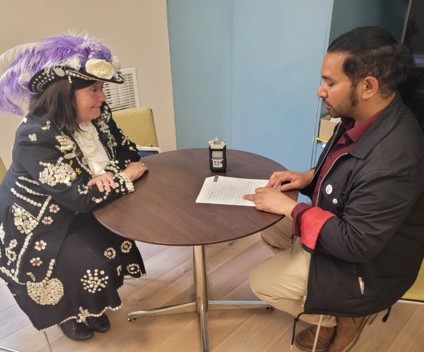
We coproduced with the University of Warwick a ground-breaking new report calling for Cockney culture to be celebrated as a community language in London, while harnessing it as a powerful tool to combat social prejudice and foster community unity.
The report, ‘A Cockney Blueprint for Tower Hamlets’ aims to empower communities, challenge stereotypes, and address social division across London. It was produced in response to Tower Hamlets Council recognising Cockney as a community language last year to provide a guide for its implementation. The study reveals experiences of language discrimination, but also the positive benefits of values of resilience and support that come from a Cockney identity. By incorporating a curriculum informed by linguistic science, the programme can become an innovative platform for social justice and socioeconomic mobility, and a model for community language programmes everywhere.
Contrary to misconceptions the study reports how Cockney was initially considered posh, serving as a label to distinguish London town dwellers from their rural neighbours. Only with the emergence of middle-class aspirations in the 18th and 19th century did elocutionists start prescribing Cockney as a lesser, non-standard, working-class way of speaking English.
The study also debunks myths around Cockney rhyming slang being born out of criminal activity, emphasising its example as a creative and playful use of language emerging from working class communities. It also highlights how Cockney has historically thrived on multicultural influences, adapting with each wave of newcomers.
Using linguistics – the science of human language – the sociolinguist experts at the University of Warwick shed light on the impact of language ideologies, revealing how evaluations of language varieties as ‘good’ or ‘bad’ are subjective social judgments, not grounded in linguistic science.
The ‘Cockney Formula’, a tool developed by Cockney Cultures, reveals how Cockney’s complex character is explained and understood through 26 different variables, although the report includes a simpler, yet insightful definition of Cockney provided by comedian Arthur Smith, as being the ‘non-posh Londoner’.
In an era where social identities are more complex, these are now more often defined beyond a single label such as ‘Cockney’ but through incarnations of ‘Cockney Bengali’, ‘Cockney Black’, ‘Cockney British’, ‘Cockney European’, ‘Cockney Indian’, ‘Cockney Jamaican’, ‘Cockney Polish’, ‘Cockney Sylheti’, and many more iterations
Dr Chris Strelluf, Associate Professor of Linguistics at the University of Warwick, and co-author of the report said, “Many studies have highlighted how injustices are perpetuated against people who speak in non-standard English varieties, these varieties include Cockney but also other regional Englishes such as Brummie, Scouse, and Geordie, Englishes associated with people of Asian and Black heritage, and foreign-accented Englishes.
“Our new report details how Cockney and other non-standard Englishes can be used in teaching about language, linguistics, and culture to empower individuals and communities, reduce language prejudice, and increase upward social mobility.”
“Although the focus of the report is Cockney, it is relevant to all ‘non-standard’ Englishes that invoke social prejudice and discrimination. Any evaluation of a language variety as ‘good’ or ‘bad’, ‘correct’ or ‘incorrect’, ‘smart’ or ‘stupid’ is a social judgement, not grounded in linguistic science.”
The report, ‘A Cockney Blueprint for Tower Hamlets’ was funded by an Economic and Social Sciences Research Council Impact Accelerator Award Rapid Response grant.
The report is a call to action, urging society to protect and nurture non-standard Englishes in the face of growing homogeneity, envisioning a future where linguistic diversity is a source of strength rather than division. Copies of the report are available at www.growsocialcapital.org.uk/cockney/Blueprint
Examples of teaching materials for how Cockney can be taught in schools as part of Tower Hamlets Council’s community language policy
Sample Lesson Plan 1: Linguistic Landscaping [insert link to www.growsocialcapital.org.uk/camapigns/cockneyblueprint ]
Sample Lesson Plan 2: Cockney Rhyming Slang [insert link to www.growsocialcapital.org.uk/camapigns/cockneyblueprint ]
Sample Lesson Plan 3: Nursery Rhymes and Cultural Heritage [insert link to www.growsocialcapital.org.uk/camapigns/cockneyblueprint ]
Here are some of the comments captured in our research group discussions:
“Everybody’s just struggling to kind of you know make ends meet, or get higher up the ladder, yet be marginalised on the basis of class, it’s absolutely important to keep these working- class cultures”.
“In the world of academia, conferences and meetings, there’s never a working-class accent. You have loads of varieties of Englishes, loads of different languages, but there’s never a working-class accent. And if you hear one, people do a real double take. And I think that they’re raising the profile of working-class culture”.
“A lot of people talked about themselves as being ‘Sylheti Cockneys’. That seems to be kind of a really valuable thing, to have that plurality of working-class culture.”
“When I first started teaching many years ago, I did lessons on Cockney rhyming slang. I wouldn’t dream of doing that now. I think it just belongs to the past.”
“I think languages just evolve and develop. Look at teenagers. One generation can’t understand the previous generations, you’ve got whole new vocabulary that they’re using and I think that’s probably always been the case.”
“Posh cockneys call themselves Londoners, whereas in Liverpool. it’s only Scouse.”
“When a Cockney plumber worked in our house my daughter says to me, ‘Mom, what language is he speaking?’ I said he’s speaking English.”
“On the one hand people born in traditional Cockney communities wants to get out of the area, but their means of getting out is based on Cockney values of resilience and resourcefulness.”
New Research Shows How Community-Led Approaches Can Transform Linguistic Inequality in London
The value and impact achieved by Grow Social Capital with its community partnership in London with the Bengali East End Heritage Society delivering the Modern Cockney Festival has been recognised in an academic study by the University of Warwick entitled, ‘Reducing standard-language-ideology conflicts through participatory research in historical sociolinguistics’.
The study argues that participatory research – when communities lead and academics support – can radically reduce conflicts fuelled by standard language ideologies. Using a multiyear collaboration with Modern Cockney in East London, the paper demonstrates how historical sociolinguistics can become publicly engaged, socially impactful, and community-driven.
The study’s authors introduce the Complementary Roles Participatory Research Model (CRPRM), which repositions academics not as directors of research but as collaborators who assist and learn from community experts. This shift, they argue, opens the door for participatory methods even in fields like historical sociolinguistics, where traditional “participants” may be distant or absent.
Modern Cockney’s Pivotal Role
The study makes clear that Modern Cockney was not simply a partner – it was the engine of the project. Its community-led initiatives shaped the research questions, methods, and outcomes, producing insights that academic researchers alone may not have uncovered.
Key contributions by Modern Cockney include:
- Reframing Cockney identity: their interviews and focus groups revealed that Cockney remains a meaningful cultural reference point for many Londoners – including young people – despite media narratives declaring it “dead”.
- Expanding Cockney identity categories: Modern Cockney identified emerging identity labels such as Bengali Cockney, Black Cockney, and Jewish Cockney, opening new avenues for community-led research.
- Challenging harmful media narratives: their work exposed how press stories about the “death of Cockney” marginalise people who still identify with Cockney heritage.
- Shifting public policy conversations: by legitimising lived experiences through linguistic evidence, the collaboration helped move Cockney identity into the political “Overton Window”, raising issues of language prejudice and social inequality on the East London policy agenda.
- Empowering community researchers: members reported feeling, for the first time, “permission to explore who I am and what my identity is,” demonstrating the personal and collective impact of the project.
Why This Matters
The study reveals how Modern Cockney’s partnership enables participatory research to:
- reduce social conflict rooted in language prejudice
- challenge institutional narratives that reinforce stereotypes
- generate new knowledge that academics would not reach alone
- create more ethical, community centred public engagement
- reshape how universities approach media, outreach, and impact
The authors conclude that the CRPRM offers a powerful new model for disciplines where participatory research has seemed impossible. By recognising the intellectual value of community-initiated, community-led research, scholars can support public outcomes that communities are already striving to achieve.
A copy of the study is here (please note, it refers to Modern Cockney’s earlier name of ‘Cockney Cultures’): https://moderncockneyfestival.co.uk/wp-content/uploads/2026/04/Cockney-Research.pdf
Commenting on the study, Andy Green of Grow Social Capital said, “The study shows a new way ahead for more profound community partnerships to discover new insights and learnings but also achieve deeper and more significant social change as a result. We hope we can build upon our Modern Cockney partnership to extend the scale and impact of our work.”